
It includes features found in no other product, such as sorting by image similarity and location of similar images. Other features include: 48-bit color and 16-bit grayscale support, contact sheets, printed catalogues, a Web Page Wizard, batch image processing, lossless JPEG rotation, watched ('hot') folders, automatic renaming, cataloguing of offline volumes, TWAIN support, and image galleries.
The program includes many image editing features, most available in batch as well as interactive mode, including: color adjustment, color depth, color balance, color profile, color replacement, histogram stretching, auto-correction, red eye removal, image stamping (text and images), alpha channel, image combination, image compare, watermarking, built-in and custom image filters, resizing, rotation, turning, mirroring, cropping, and trimming to proportion.
ThumbsPlus supports viewing and slide shows of raster, vector, multimedia and font files. Plug-ins are available in the Professional and Network versions for raw files from almost all digital cameras, Postscript, PDF, EPS and AI files, and EC Software IPP files.
ThumbsPlus uses a Microsoft Access (JET) database by default, but the Professional version can also use the following databases: SQL Server 2000 & 2005, Sybase SQL Anywhere, MySQL, PostgreSQL, Firebird, IBM DB2.
ThumbsPlus can share a database between multiple users and multiple computers, from a small workgroup to a large enterprise.
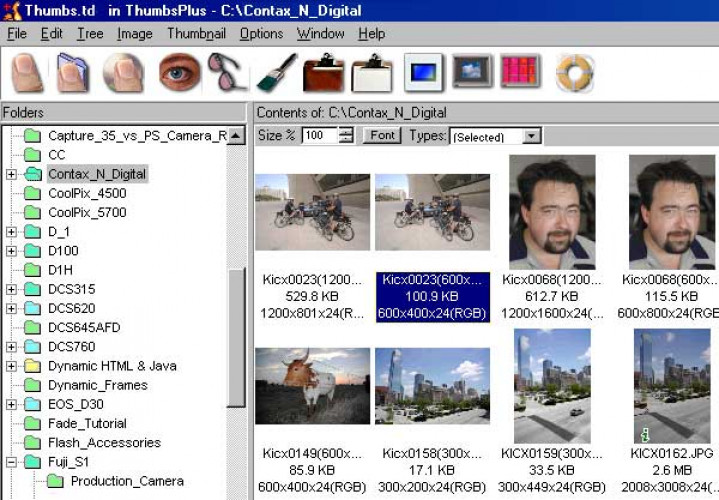
Assuming you have a relatively new CPU (ca. 2009 or newer) and the appropriate amount of RAM for your workload (generally at least 2GB), an SSD is likely the best way to obtain immediate performance improvement for your system in general and ThumbPlus in particular.
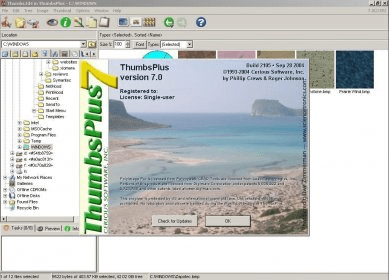
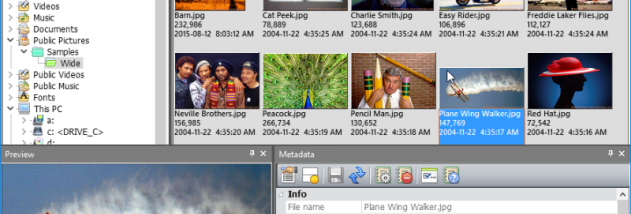
For 25 years, ThumbsPlus has pioneered database-driven image management software for Windows that is versatile and powerful, yet easy to use. With ThumbsPlus you manage, retrieve, catalog, sort. Download ThumbsPlus free. ThumbsPlus is the premier image, font and media management tool. Here is a screen shot from Windows 8. Don't install ThumbsPlus on a network or external drive. If you share ThumbsPlus between multiple users, it is best to install it locally on each user's system, on either a hard drive or SSD. Don't put the ThumbsPlus database on a network drive unless you're sharing it.

I recommend modern SSDs (from 2012 or later), as many of the earlier SSDs had poor write performance, limited lifetime, and rapid performance degradation with a heavy disk write volume. Make sure the SSD you purchase has wear-leveling and implements TRIM. I've bought most of mine from newegg.com. Read the reviews to find the best value.
Here are some hints for the best utilization of SSDs:
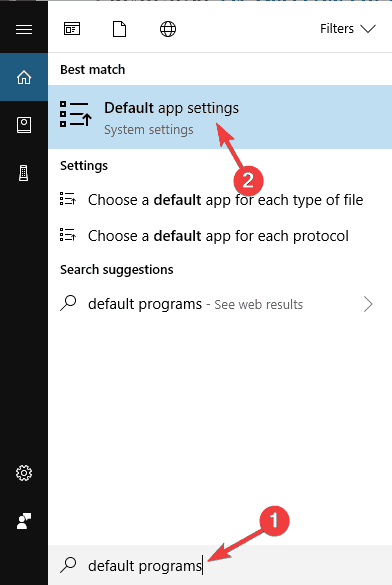
Thumbsplus For Windows 10
Thumbsplus For Windows 10
Make the SSD your Windows boot disk for immediate performance improvements in booting, starting programs, disk accesses, database accesses, and just about everything you do.
Install ThumbsPlus on the SSD to improve program startup speed.
Create or copy your ThumbsPlus database to the SSD. Especially for a large database, this will improve the performance for thumbnail creation (Thumbnail · Make... and Thumbnail · Scan...), loading folders and thumbnails from the database, finding thumbnails (Edit · Find), and processing batches of thumbnails; for example, assigning keywords (Thumbnail · Keywords), setting user fields (Thumbnail · Assign user fields) and modifying file info (Thumbnail · Modify file info).
Even if you are accessing the thumbnail database over a network connection (whether the built-in .tpdb8 or client/server), you'll see improvement from an SSD as long as your network is relatively fast and not over-saturated.
For client/server databases with full recovery logging, you'll get the most improvement by placing the database itself on SSD. The log file should be on a separate disk, but it can be on a fast HD since it is written sequentially. It's best to preallocate the full log file size to avoid repeated log file extending and fragmenting.
For client/server database with simple logging, both the log and database can be on the same SSD because simple logging does not use the log the same way as full recovery logging.. See the Client/Server Databases page for additional information about logging and recovery models.
- Large images and movies can remain on HD. Sequential access to large files is not improved as much by using an SSD, because disk seeking is much lest frequent. Be sure to defragment your hard disks regularly!